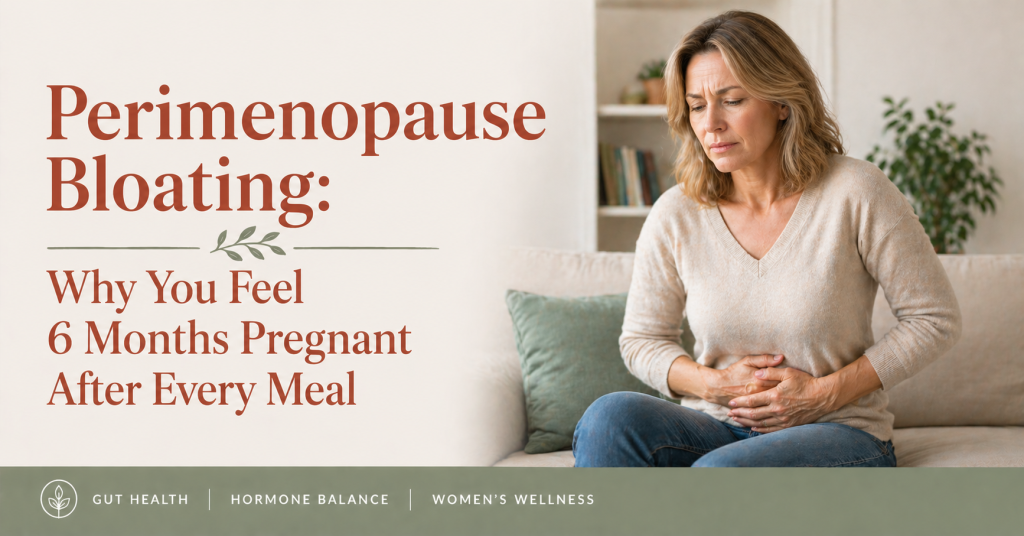
You eat a normal meal — nothing unusual, nothing you haven’t eaten a hundred times before — and within an hour your waistband is cutting into you, your stomach is visibly distended, and you feel like you need to lie down. By evening you look and feel physically pregnant. By morning it’s gone, and the cycle starts again.
If this is your daily reality, you are not imagining it and you are not alone. Bloating is one of the most common and most demoralising symptoms of perimenopause — partly because it seems so disproportionate to what you’ve actually eaten, partly because it’s invisible to everyone else, and partly because the standard advice (eat more slowly, try probiotics, cut out fizzy drinks) rarely touches it.
The reason that advice doesn’t work is that it treats perimenopause bloating as a digestive problem. It isn’t — or at least, it isn’t only that. It’s a hormonal problem with digestive consequences, and understanding the difference is the key to actually fixing it.
Episode: “Why Perimenopause Bloating Is Different — And What Actually Helps” — Real Food Science Podcast
Key Takeaways
- Perimenopause bloating is driven by at least five distinct mechanisms — hormonal, microbiome, gut permeability, motility, and food-trigger related — and most women have more than one operating simultaneously
- Falling oestrogen and progesterone directly change how your gut functions, independently of anything you eat
- The foods most commonly triggering midlife bloating are not the ones most women suspect first
- Identifying your personal trigger pattern — not following a generic elimination diet — is the most effective approach
- The 7-Day Gut Reset addresses the gut repair side; the Bloat Trigger Discovery Worksheet addresses the personal trigger identification side
Why Perimenopause Bloating Is Different From Normal Bloating
Everyone experiences occasional bloating. Eat too much, drink too fast, have a stomach bug — bloating is a normal physiological response in those contexts.
Perimenopause bloating is categorically different. It’s persistent, unpredictable, disproportionate to food intake, and frequently unresponsive to the interventions that work for standard digestive bloating. Women describe it as feeling like a switch has been flipped — digestion that was broadly reliable for decades suddenly becomes erratic, uncomfortable, and frankly embarrassing.
The reason is that perimenopause changes the gut environment itself — not just what you eat, but how your entire digestive system functions. There are at least five mechanisms operating simultaneously in most perimenopausal women with significant bloating. Understanding which ones apply to you is what makes the difference between approaches that help and approaches that don’t.
Mechanism 1: Falling Progesterone Slows Everything Down
Progesterone is the first hormone to decline significantly in perimenopause — often years before oestrogen drops noticeably. What most women don’t know is that progesterone directly regulates gut motility — the muscular contractions that move food through the digestive tract.
Progesterone relaxes smooth muscle tissue. This is its purpose during pregnancy, when it prevents premature uterine contractions. But it also relaxes the smooth muscle of the intestinal wall. When progesterone is high, digestion slows. This is why constipation is so common in the second half of the menstrual cycle, and why pregnancy often comes with significant digestive sluggishness.
In early perimenopause, progesterone levels become erratic — sometimes high, sometimes low, sometimes crashing mid-cycle. This creates an equally erratic digestive pattern: sometimes constipated, sometimes looser, sometimes alternating. Food sits in the gut longer than it should, fermenting and producing gas. The bloating that follows is not caused by what you ate — it’s caused by how long it stayed in your gut before moving through.
This mechanism also explains why bloating in perimenopause is often worse in the second half of your cycle (if you’re still cycling), and why it may improve slightly during and after your period when progesterone is at its lowest.
Mechanism 2: Falling Oestrogen Changes Your Gut Microbiome
As we covered in detail in the gut-hormone connection article, oestrogen directly influences the composition and diversity of your gut microbiome. It supports the growth of beneficial Lactobacillus species, helps maintain the integrity of the gut lining, and regulates the immune activity in the gut wall.
As oestrogen declines, several things happen simultaneously:
Beneficial bacterial species decline. Lactobacillus populations — which produce lactic acid, maintain gut pH, and compete with gas-producing bacteria — fall. The gap is filled by bacteria that produce more hydrogen and methane gas during fermentation. The same foods that previously produced minimal gas now produce significantly more.
Gas-producing species proliferate. In a lower-oestrogen gut environment, bacteria from the Clostridia family and various proteolytic species are less well-controlled. These species ferment food residues that beneficial bacteria would have processed cleanly, producing the excess gas that drives distension.
The gut becomes more reactive. With less oestrogen to modulate gut immune activity, the gut wall becomes more sensitive to foods, additives, and bacterial signals that it previously tolerated without reaction.
This explains one of the most common and bewildering experiences of perimenopause: foods that never caused any problem — onions, garlic, apples, beans, wholegrains — suddenly cause significant bloating. The food hasn’t changed. Your gut’s ability to process it has.
Mechanism 3: Increased Gut Permeability
The gut lining is a single-cell-layer barrier, held together by tight junction proteins. When these proteins are functioning well, the gut selectively absorbs nutrients while keeping bacteria, toxins, and undigested food particles out of the bloodstream.
Oestrogen plays a direct role in maintaining tight junction integrity. As it declines, tight junctions loosen — a process that is further worsened by high omega-6 seed oil intake, chronic stress, alcohol, and certain food additives including emulsifiers.
When the gut lining becomes more permeable, two things relevant to bloating happen. First, bacterial fragments called lipopolysaccharides (LPS) enter the bloodstream, triggering an immune response that produces systemic inflammation — and gut inflammation specifically, which contributes to the sensitisation and reactivity behind bloating. Second, undigested food particles that pass through the loosened junctions trigger localised immune responses in the gut wall — responses that manifest as bloating, cramping, and digestive discomfort.
This is why many perimenopausal women develop what feels like new food intolerances. It’s not that they’ve become intolerant to those foods in the classical sense. It’s that their gut lining is no longer providing the barrier function that previously prevented those foods from triggering an immune response.
Mechanism 4: Cortisol and the Gut-Brain Axis
The gut and brain are connected via the vagus nerve in a bidirectional communication system — the gut-brain axis. When your brain is in a state of stress or threat, it signals the gut to slow down, reduce secretion of digestive enzymes, and alter motility. This was useful when stress meant running from a predator. It’s less useful when stress means a difficult week at work or a poorly sleeping night from hot flashes.
Cortisol — which we covered in depth in the cortisol and sleep article — is chronically elevated in many perimenopausal women due to sleep disruption, life pressures, and the direct HPA axis sensitisation caused by declining oestrogen. Elevated cortisol does three things to the gut that drive bloating:
It reduces production of digestive enzymes, meaning food arrives in the lower gut less well digested and more available for bacterial fermentation. It alters gut motility, sometimes speeding up transit (loose stools, urgency) and sometimes slowing it (constipation, gas). And it increases gut permeability directly — the same tight junction loosening described above, but triggered from the brain end of the axis rather than the dietary end.
This is why bloating is reliably worse on stressful days — not just in your imagination, but because of a direct physiological pathway from stress to gut dysfunction.

Mechanism 5: The Food Triggers Specific to Perimenopausal Women
Against this already-compromised backdrop, certain foods reliably amplify bloating in ways they didn’t before perimenopause. The most common — and the ones most worth identifying in your own diet — are:
Fructans (onion, garlic, leek, wheat) Fructans are fermentable carbohydrates that gut bacteria break down with significant gas production. In a healthy, diverse gut microbiome, this fermentation is relatively efficient. In the dysbiotic, lower-diversity gut of perimenopause, fructan fermentation produces far more gas. Onion and garlic are the most potent fructan sources and are frequently identified as significant triggers in perimenopausal women who previously tolerated them well.
Excess fructose (fruit juice, honey, agave, large fruit portions) Fructose malabsorption — where fructose is not fully absorbed in the small intestine and passes to the colon for fermentation — becomes more common with age and hormonal change. Large portions of fruit, fruit juice, honey, and agave syrup are the most common culprits. This doesn’t mean fruit is problematic — it means portion size and timing matter more than they did in your thirties.
Lactose (milk, soft cheese, cream) Lactase enzyme activity declines with age. Women who tolerated dairy comfortably in their twenties and thirties sometimes find it triggers significant bloating in their forties — not because of a new allergy, but because of the natural age-related reduction in their ability to digest lactose. Hard, aged cheeses contain negligible lactose and are typically tolerated well. Milk, soft cheese, and cream are the most common triggers.
Emulsifiers in ultra-processed foods Polysorbate-80, carboxymethylcellulose, and carrageenan — emulsifiers found in many packaged foods including plant-based milks, salad dressings, ice cream, and processed sauces — have been shown in controlled studies to disrupt the gut mucus layer and alter microbiome composition in ways that increase intestinal permeability and produce bloating. For women whose gut lining is already compromised by falling oestrogen, these compounds are a significant but often overlooked trigger.
Alcohol — particularly wine Beyond its direct effect on gut permeability, alcohol specifically disrupts the balance of gut bacteria within hours of consumption. Wine in particular contains sulphites that can trigger inflammatory gut responses in sensitive individuals. Many perimenopausal women notice a strong correlation between an evening glass of wine and next-day bloating — and this is the mechanism.
Seed oils and fried foods As detailed in the hidden seed oils article, high omega-6 oils directly disrupt tight junction proteins in the gut wall. This is a longer-term effect rather than an immediate post-meal trigger — but a daily seed oil load maintains the gut permeability that makes every other trigger more potent.
Why Generic Elimination Diets Don’t Work For Perimenopause Bloating
The standard advice for bloating is some version of a low-FODMAP diet — eliminating fermentable carbohydrates to reduce the substrate available for bacterial fermentation. This works reasonably well for IBS in younger adults. It works poorly for perimenopause bloating for several reasons.
First, it addresses only one of the five mechanisms above — the fermentation mechanism. It does nothing for gut permeability, microbiome dysbiosis, motility changes, or the cortisol pathway.
Second, low-FODMAP diets are by definition low in the diverse plant fibre that gut bacteria need to survive. Following a strict low-FODMAP approach for more than a few weeks worsens microbiome diversity — which worsens the underlying gut dysfunction that’s making fermentation a problem in the first place. It treats the symptom while worsening the cause.
Third, triggers are individual. The foods that cause significant bloating for one perimenopausal woman are often tolerated without issue by another. A blanket elimination protocol cannot identify your personal trigger pattern — only systematic, personalised tracking can do that.
The approach that works for perimenopause bloating is two-pronged: address the gut environment through anti-inflammatory eating and gut repair, while simultaneously identifying your personal trigger foods through structured tracking. These two interventions together produce results that neither achieves alone.
What Actually Helps: The Two-Pronged Approach
Prong 1: Repair the gut environment
This means reducing the inputs that are maintaining gut permeability and microbiome dysbiosis — seed oils, emulsifiers, alcohol, ultra-processed foods — and increasing the inputs that repair and support the gut lining: diverse plant fibre, fermented foods, polyphenol-rich foods, and anti-inflammatory fats.
This isn’t a two-week fix. Meaningful microbiome recovery takes four to eight weeks of consistent dietary change. But most women notice a significant reduction in baseline bloating within two to three weeks of reducing the main gut disruptors, even before the deeper microbiome changes consolidate.
The 7-Day Gut Reset is designed specifically for this first repair phase — seven days of gut-healing foods, daily gut repair habits, and a bloating tracker that makes the improvement visible as it happens.
Prong 2: Identify your personal triggers
Once the gut environment is less inflamed and more resilient, specific trigger foods become much easier to identify — because your baseline bloating is lower, making the effect of individual foods clearer against that lower background.
Tracking your meals and symptoms systematically for two to four weeks, with enough structure to see patterns, is the most reliable way to identify your personal trigger list. The Bloat Trigger Discovery Worksheet below gives you that structure.
Free Resource: Identify Your Personal Triggers
Every woman’s bloat trigger pattern is slightly different — and knowing yours is the difference between vague dietary changes that sometimes help and targeted changes that consistently do.
→ Download the free Bloat Trigger Discovery Worksheet — a structured 7-day tracking tool that helps you identify your specific trigger patterns and turn that knowledge into a personalised action plan.
Ready to Break the Bloating Cycle?
The 7-Day Gut Reset — End Menopause Bloating gives you a complete seven-day plan built around the gut-repair foods and habits that address the underlying mechanisms behind perimenopause bloating — not just the symptoms. Seven days of knowing exactly what to eat, why you’re eating it, and what to expect as the bloating cycle breaks.
FAQ
Why is my bloating worse in the second half of my cycle? Progesterone peaks in the luteal phase (roughly days 15–28 if you’re still cycling). As covered above, progesterone slows gut motility, leading to longer transit times, more fermentation, and more gas production. This is a direct hormonal effect, not a food effect — though food choices can amplify or dampen it. If your bloating follows a clear cyclical pattern, progesterone motility changes are almost certainly the primary driver.
Could my bloating be SIBO (small intestinal bacterial overgrowth)? SIBO — where bacteria from the large intestine migrate into and colonise the small intestine — does become more common during perimenopause, partly because of the motility changes described above. It produces bloating that typically begins within 60–90 minutes of eating rather than hours later, and is often accompanied by significant upper abdominal distension. If your bloating is consistently early-onset and severe, SIBO is worth investigating with a GP or gastroenterologist. The dietary approaches in this article support SIBO management but are not a substitute for diagnosis and treatment if SIBO is present.
I’ve tried cutting gluten and dairy and it didn’t help. Does that mean food isn’t the issue? Not necessarily. Gluten and dairy are the two most commonly eliminated foods, but they are not the most common triggers for perimenopause-specific bloating. Fructans (onion, garlic, wheat) and emulsifiers in packaged foods are frequently more significant. The fact that standard elimination hasn’t helped is more likely a sign that you haven’t yet identified your specific triggers than that food isn’t involved.
Is bloating in perimenopause ever a sign of something more serious? Bloating that is new, persistent, and accompanied by changes in bowel habits, unexplained weight loss, or abdominal pain warrants investigation by a GP to rule out conditions including ovarian cancer, coeliac disease, and inflammatory bowel disease. Perimenopause bloating is common and benign, but significant new symptoms should always be evaluated medically before attributing them to hormonal change.
Will HRT help with bloating? HRT addresses the hormonal component of perimenopause bloating — particularly the oestrogen-related gut permeability and microbiome changes. Many women on HRT notice an improvement in digestive symptoms. However, HRT does not address the food trigger component, and some women find that certain forms of HRT (particularly oral oestrogen) initially worsen bloating before improving it. Dietary approaches and HRT are complementary, not competing.
Sources
- Baker, J.M. et al. (2017). Estrogen-gut microbiome axis: physiological and clinical implications. Maturitas, 103.
- Cani, P.D. et al. (2007). Metabolic endotoxaemia initiates obesity and insulin resistance. Diabetes, 56(7).
- Chassaing, B. et al. (2015). Dietary emulsifiers impact the mouse gut microbiota promoting colitis and metabolic syndrome. Nature, 519.
- Rao, S.S. & Kavlock, R. (2006). Influence of body position and stool characteristics on defecation in humans. American Journal of Gastroenterology, 101(12).
- Vieira, A.T. et al. (2017). Influence of oral and gut microbiota in the health of menopausal women. Frontiers in Microbiology, 8.
- Stasi, C. et al. (2019). The relationship between the serotonin metabolism, gut-microbiota and the gut-brain axis. Current Drug Metabolism, 20(8).
- Gibson, P.R. & Shepherd, S.J. (2010). Evidence-based dietary management of functional gastrointestinal symptoms. Journal of Gastroenterology and Hepatology, 25(2).
Related Articles
- The Gut-Hormone Connection: How Your Microbiome Shapes Menopause
- Hidden Seed Oils in ‘Healthy’ Foods You Probably Buy Every Week
- 7 Foods That Help Hot Flashes Naturally
- What Actually Happens to Your Body on a 30-Day Anti-Inflammatory Diet