You’ve probably heard that your gut health matters. Eat more fibre, take a probiotic, cut out processed food — the advice is everywhere. But what most of it leaves out is the part that matters most for women in perimenopause and menopause: your gut bacteria don’t just affect your digestion. They directly regulate your hormones.
There is a specific community of gut bacteria — researchers now call it the estrobolome — whose entire job is to metabolise oestrogen. When that community is healthy and diverse, it processes and recirculates oestrogen efficiently, helping to maintain the hormonal balance your body is already working hard to preserve during transition. When it’s disrupted — by antibiotics, ultra-processed foods, chronic stress, or years of low-fibre eating — that process breaks down.
The result isn’t just bloating or irregular digestion. It’s worsened hot flashes. More severe brain fog. Greater mood instability. Increased joint pain. Deeper fatigue.
Your gut is not a bystander in your menopause experience. It is an active participant — and the good news is that it’s one of the most responsive systems in your body to dietary change.
Episode: “Your Gut Is Running Your Hormones — Here’s the Proof” — Real Food Science Podcast
Key Takeaways
- The estrobolome is the collection of gut bacteria responsible for metabolising oestrogen — its health directly influences menopause symptom severity
- A disrupted gut microbiome impairs oestrogen recycling, accelerating the hormonal decline that drives hot flashes, brain fog, and mood changes
- Gut permeability (leaky gut) increases during menopause transition and amplifies systemic inflammation
- Diversity of gut bacteria — measured by the number of distinct species — is the single most important marker of a healthy microbiome
- Dietary fibre, specifically diverse plant fibre, is the primary driver of microbiome diversity and estrobolome health
- Measurable changes in gut bacterial composition can occur within two to four weeks of significant dietary change
What the Estrobolome Actually Is
The term estrobolome was coined by researchers studying the relationship between gut bacteria and breast cancer risk — and what they found has profound implications for every woman going through hormonal transition.
Here’s how it works in plain English.
Your liver processes oestrogen and tags it for excretion, sending it to the gut in a form called conjugated oestrogen. Certain gut bacteria produce an enzyme called beta-glucuronidase, which deconjugates that oestrogen — essentially unlocking it — allowing it to be reabsorbed into the bloodstream and recirculated rather than eliminated.
When your estrobolome is balanced, this recycling process is tightly regulated. Just the right amount of oestrogen is recirculated; the rest is safely excreted. When your estrobolome is disrupted — a state called dysbiosis — one of two things can happen:
Too little beta-glucuronidase activity: Not enough oestrogen gets recirculated. Oestrogen levels drop faster and lower than they would otherwise. Hot flashes become more frequent, mood becomes more volatile, bone density loss accelerates.
Too much beta-glucuronidase activity: Excess oestrogen is reabsorbed. This can contribute to oestrogen dominance — heavy or irregular periods, breast tenderness, worsened PMS — which is common in early perimenopause when progesterone drops first.
In both cases, dysbiosis is amplifying the hormonal chaos of perimenopause rather than helping to buffer it. And dysbiosis is extremely common in Western women — not because of any individual failure, but because the modern diet is structurally low in the fibre and plant diversity that healthy gut bacteria need to thrive.
The Menopause-Microbiome Feedback Loop
The relationship between your gut and your hormones isn’t one-directional. Oestrogen also influences the gut — maintaining the integrity of the gut lining, supporting mucus production, and modulating the immune activity in the gut wall. As oestrogen declines during perimenopause, the gut becomes more vulnerable on multiple fronts simultaneously.
Research published in Cell Host & Microbe found that postmenopausal women showed significantly lower gut microbiome diversity than premenopausal women of similar age and diet — a shift driven at least in part by the loss of oestrogen’s protective effects on gut tissue. The same study found that this diversity loss correlated with increased systemic inflammation markers.
This creates a feedback loop that most conventional menopause advice completely misses:
- Falling oestrogen → reduced gut barrier integrity → increased intestinal permeability
- Increased permeability → bacterial fragments enter the bloodstream → immune system activates → systemic inflammation rises
- Higher inflammation → hypothalamus becomes more reactive → hot flashes worsen, brain fog deepens
- Meanwhile, dysbiosis → impaired estrobolome → oestrogen recycling disrupted → hormonal decline accelerates
- Accelerated hormonal decline → gut health worsens further → loop repeats
Breaking this loop through food is genuinely possible — and it works faster than most people expect.
What Disrupts Your Estrobolome
Understanding what damages the estrobolome helps explain why so many women find their gut health deteriorating precisely when their menopause symptoms are worsening. The main culprits:
Ultra-processed foods: Emulsifiers, artificial sweeteners, and refined carbohydrates have been shown in multiple studies to alter gut bacterial composition, reduce diversity, and increase gut permeability within weeks of sustained consumption. The 2022 NOVA dietary classification study linked higher ultra-processed food consumption directly with lower microbiome diversity in women.
Low dietary fibre: Gut bacteria are fed by fibre — specifically fermentable fibre from plant foods. Without adequate fibre, beneficial species decline and inflammatory species fill the gap. The average Western adult eats around 15–18g of fibre per day; research suggests 30–35g is closer to what a diverse microbiome requires.
Antibiotics: Even a single short course can reduce gut bacterial diversity by up to 30%, with effects lasting months in some individuals. This doesn’t mean avoiding necessary antibiotics — but it does mean that women who’ve had frequent antibiotic courses over the years may have a more depleted starting point for microbiome recovery.
Chronic stress: The gut-brain axis is bidirectional — psychological stress alters gut motility, reduces mucus production, and changes bacterial composition through cortisol’s effects on gut tissue. For women navigating the life pressures that often coincide with perimenopause, this is a meaningful amplifier.
Seed oils and oxidised fats: As covered in the seed oils and menopause inflammation article, high omega-6 polyunsaturated fats disrupt tight junction proteins in the gut wall and promote an inflammatory bacterial profile. This is one of the mechanisms through which diet and gut health overlap most directly.
The Role of Gut Permeability in Menopause Symptoms
Intestinal permeability — often called leaky gut — deserves its own section because it’s one of the most clinically significant and least-discussed mechanisms in menopause symptom management.
Your gut lining is a single cell layer thick. It is meant to be selectively permeable — letting nutrients through while keeping bacteria, toxins, and undigested food particles out. Tight junction proteins hold these cells together. When those proteins are disrupted — by dysbiosis, low oestrogen, high omega-6 fats, or chronic stress — gaps open between cells.
When bacterial fragments called lipopolysaccharides (LPS) slip through those gaps into the bloodstream, your immune system treats them as an invasion. The response is immediate and systemic: inflammatory cytokines flood the circulation. This is called metabolic endotoxaemia, and a landmark 2007 paper by Cani et al. in Diabetes showed it could be triggered simply by a high-fat, low-fibre meal — producing a two to three times increase in circulating LPS within hours.
For a perimenopausal woman whose inflammatory baseline is already elevated by falling oestrogen, repeated episodes of metabolic endotoxaemia are like throwing petrol on a fire. Every meal that triggers it — usually a high-fat processed meal, not a whole food one — produces a wave of inflammatory signalling that sensitises the hypothalamus, strains the immune system, and leaves you feeling bloated, foggy, achy, and exhausted.
Healing the gut lining, by contrast, reduces this endotoxin leak, lowers the inflammatory burden, and produces symptomatic improvements that go well beyond digestion.
What Actually Heals and Diversifies Your Microbiome
Fibre — but specifically diverse plant fibre
This is the single most important dietary intervention for microbiome health, and it’s worth understanding why diversity of fibre sources matters as much as quantity.
Different species of gut bacteria feed on different types of fibre. Bifidobacterium species prefer inulin-type fructans, found in chicory, onions, garlic, and asparagus. Lactobacillus species thrive on pectin from fruits and root vegetables. Akkermansia muciniphila — a species strongly associated with gut barrier integrity — is fed by polyphenols from berries and dark chocolate. Faecalibacterium prausnitzii, one of the most important anti-inflammatory bacteria in the gut, thrives on the resistant starch in cooked and cooled potatoes, legumes, and unripe bananas.
You cannot feed all of these species with a single type of fibre. This is why the research from the American Gut Project, one of the largest citizen science microbiome studies ever conducted, found that eating 30 or more different plant foods per week was the strongest single predictor of gut microbiome diversity — stronger than whether someone was vegan, vegetarian, or omnivorous.
Thirty plants sounds like a lot. In practice, it’s more accessible than it appears. Every distinct plant food counts — herbs, spices, nuts, seeds, grains, legumes, fruits, and vegetables are all in. A bowl of porridge with ground flaxseed, walnuts, and blueberries is already four plants before you’ve reached lunchtime.
Fermented foods
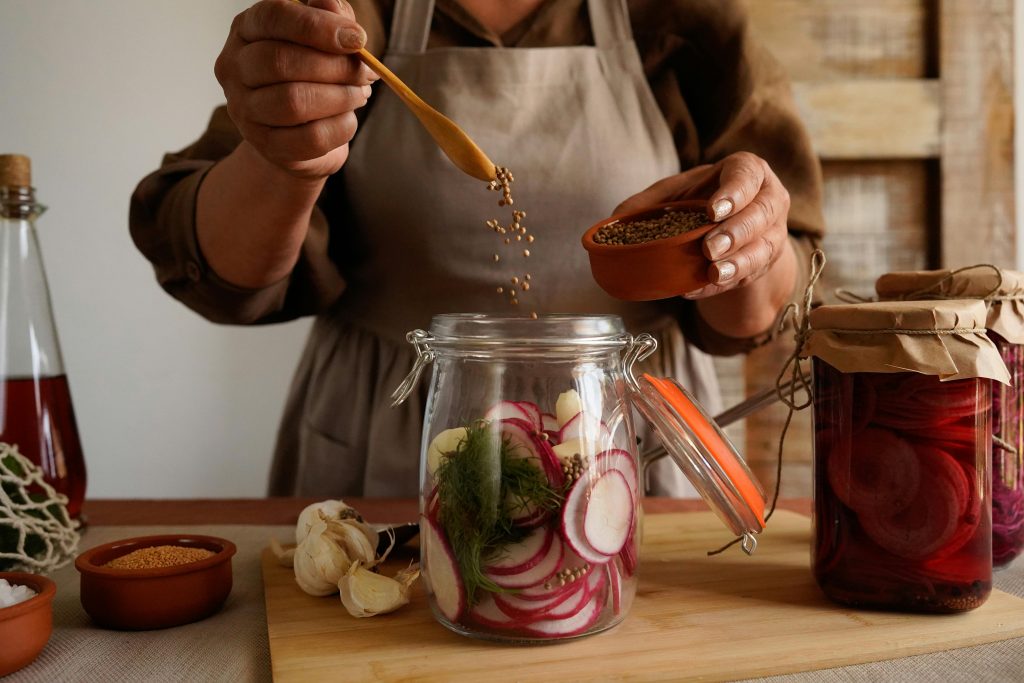
Fermented foods — live yoghurt, kefir, kimchi, sauerkraut, miso, tempeh — introduce beneficial bacterial strains and produce short-chain fatty acids (SCFAs) that directly nourish gut lining cells. A landmark 2021 study in Cell by Wastyk et al. found that a high-fermented-food diet increased microbiome diversity and reduced inflammatory markers over ten weeks — while a high-fibre diet without fermented foods produced more variable results.
For best results, combine both: use fibre to feed resident bacteria and fermented foods to introduce and reinforce beneficial species. Two to three servings of fermented foods per day is the target — a portion of live yoghurt, a small glass of kefir, or a tablespoon of kimchi or sauerkraut with a meal.
Polyphenol-rich foods
Polyphenols — the compounds that give berries, dark chocolate, green tea, coffee, and extra virgin olive oil their colour and bitterness — are not just antioxidants. They are prebiotics. Gut bacteria ferment polyphenols into bioactive metabolites including urolithins, equol, and various SCFAs that reduce inflammation, support gut barrier function, and regulate immune activity.
A diet rich in polyphenols consistently predicts higher microbiome diversity and lower inflammatory markers in population studies. Conveniently, the foods highest in polyphenols — berries, leafy greens, olive oil, legumes, herbs and spices — are the same foods that help with hot flashes through other pathways. The more you eat across these categories, the more reinforcing the effect.
Reducing gut disruptors
Adding beneficial foods works significantly better when you’re simultaneously reducing what disrupts the microbiome. The practical targets are: ultra-processed foods (emulsifiers in particular), artificial sweeteners including erythritol and sucralose, alcohol in regular amounts, and seed oils as a primary cooking fat.
This doesn’t require perfection. An 80% whole food diet produces dramatically better microbiome outcomes than a 50% one. Consistency over perfection — the threshold for meaningful improvement is accessible without being extreme.
The 90-Day Timeline: What to Expect
Gut bacterial composition can change remarkably quickly — studies have shown measurable shifts within two weeks of dietary change. But sustainable, deep improvement in microbiome diversity takes longer, and the estrobolome specifically takes time to restabilise.
A realistic timeline for women using a food-first approach:
Weeks 1–2: Reduced bloating and wind as fermentable fibre intake adjusts. Some women experience a temporary increase in bloating in the first week as bacterial populations shift — this is normal and resolves.
Weeks 3–4: Improved stool regularity, reduced digestive discomfort, early improvements in energy and sleep quality as inflammatory markers begin to fall.
Weeks 5–8: Measurable improvements in hot flash frequency and brain fog for most women. Mood stability improves as the gut-brain axis recalibrates.
Weeks 9–12: Deeper microbiome diversity improvements consolidated. Oestrogen metabolism begins to stabilise. Women typically report feeling meaningfully better than at the start — not just digestively, but systemically.
This is why the Fiber-Maxxing 90-Day Gut-Brain Protocol is structured around three months rather than one. The first month builds the foundation. The second deepens it. The third consolidates it into a sustainable pattern that keeps working.
Free Resource: Find Your Bloat Triggers
Before you can fix your gut, it helps to understand what’s disrupting it. The most common bloat triggers in perimenopause aren’t always the ones you’d expect — and they vary between women.
→ Download the free Bloat Trigger Discovery Worksheet — a practical tool that helps you map your specific bloating patterns, identify the most likely food and lifestyle triggers, and prioritise the changes that will move the needle fastest for you.
Go Deeper: The Fiber-Maxxing 90-Day Gut-Brain Protocol
If you’re ready to go beyond individual food swaps and build a genuinely diverse, hormonally supportive microbiome — with a tracker, a structure, and a clear progression — the Fiber-Maxxing 90-Day Gut-Brain Protocol is the most comprehensive resource I’ve created on gut health for menopause.
It includes a diversity tracker, a weekly plant-count system, fermented food integration guides, and a progressive fibre-building structure designed to avoid the bloating overwhelm that comes from adding too much too fast. Ninety days to a genuinely different gut — and a genuinely different menopause experience.
FAQ
What is the estrobolome and why have I never heard of it? The estrobolome is the collection of gut bacteria that metabolise oestrogen. It’s a relatively recent area of research — the term was coined in 2012 — which is why it hasn’t filtered through to mainstream menopause advice yet. But the research is compelling and consistent: women with healthier, more diverse gut microbiomes have better hormonal balance and fewer severe menopause symptoms.
Can I test my estrobolome? Direct estrobolome testing isn’t widely available, but comprehensive gut microbiome testing services (like Biomesight, Thriva, or similar) can give you a picture of your overall bacterial diversity and flag whether certain key species are low. These tests are a useful starting point but not essential — the dietary approach that supports the estrobolome benefits the whole microbiome regardless.
Should I take a probiotic? Probiotics can be a useful addition, particularly after antibiotics or during a period of significant dietary transition, but they are not a replacement for dietary fibre. Think of probiotics as planting seeds and dietary fibre as the water and soil — without the fibre, even good bacteria don’t establish and thrive. If you do take a probiotic, look for multi-strain formulas with at least five to ten billion CFUs, and store them correctly.
I’ve been eating well for years and still have gut problems. Why? Gut microbiome disruption can persist for years after the initial insult — antibiotic courses, periods of high stress or ultra-processed food eating, or simply years of insufficient fibre. The gut does regenerate, but it needs consistent fibre diversity and time. Many women find that the problem isn’t what they’re eating now but what they’ve historically not been eating enough of — specifically, the variety of plant fibre that diverse gut bacteria need.
Is fermented food safe if I have histamine intolerance? Fermented foods are naturally high in histamine, which can be problematic for women with histamine intolerance — a condition that worsens for some women during perimenopause as oestrogen influences histamine clearance. If you notice worsening symptoms (flushing, headaches, heart palpitations, skin reactions) after eating fermented foods, it’s worth exploring histamine intolerance with a qualified practitioner before increasing fermented food intake.
Sources
- Plottel, C.S. & Blaser, M.J. (2011). Microbiome and malignancy. Cell Host & Microbe, 10(4).
- Kwa, M. et al. (2016). The intestinal microbiome and estrogen receptor-positive female breast cancer. Journal of the National Cancer Institute, 108(8).
- Baker, J.M. et al. (2017). Estrogen-gut microbiome axis: physiological and clinical implications. Maturitas, 103.
- Cani, P.D. et al. (2007). Metabolic endotoxaemia initiates obesity and insulin resistance. Diabetes, 56(7).
- Wastyk, H.C. et al. (2021). Gut-microbiota-targeted diets modulate human immune status. Cell, 184(16).
- McDonald, D. et al. (2018). American Gut: an open platform for citizen science microbiome research. mSystems, 3(3).
- Vieira, A.T. et al. (2017). Influence of oral and gut microbiota in the health of menopausal women. Frontiers in Microbiology, 8.